> For the complete documentation index, see [llms.txt](https://docs.deepconverse.com/product-docs/llms.txt). Markdown versions of documentation pages are available by appending `.md` to page URLs; this page is available as [Markdown](https://docs.deepconverse.com/product-docs/chatbots/deploy/adding-widget-to-your-website.md).
# Adding widget to your website
You can add the chatbot to your website by following the steps below.
1. Open the Chatbot that you are planning to add to your help center
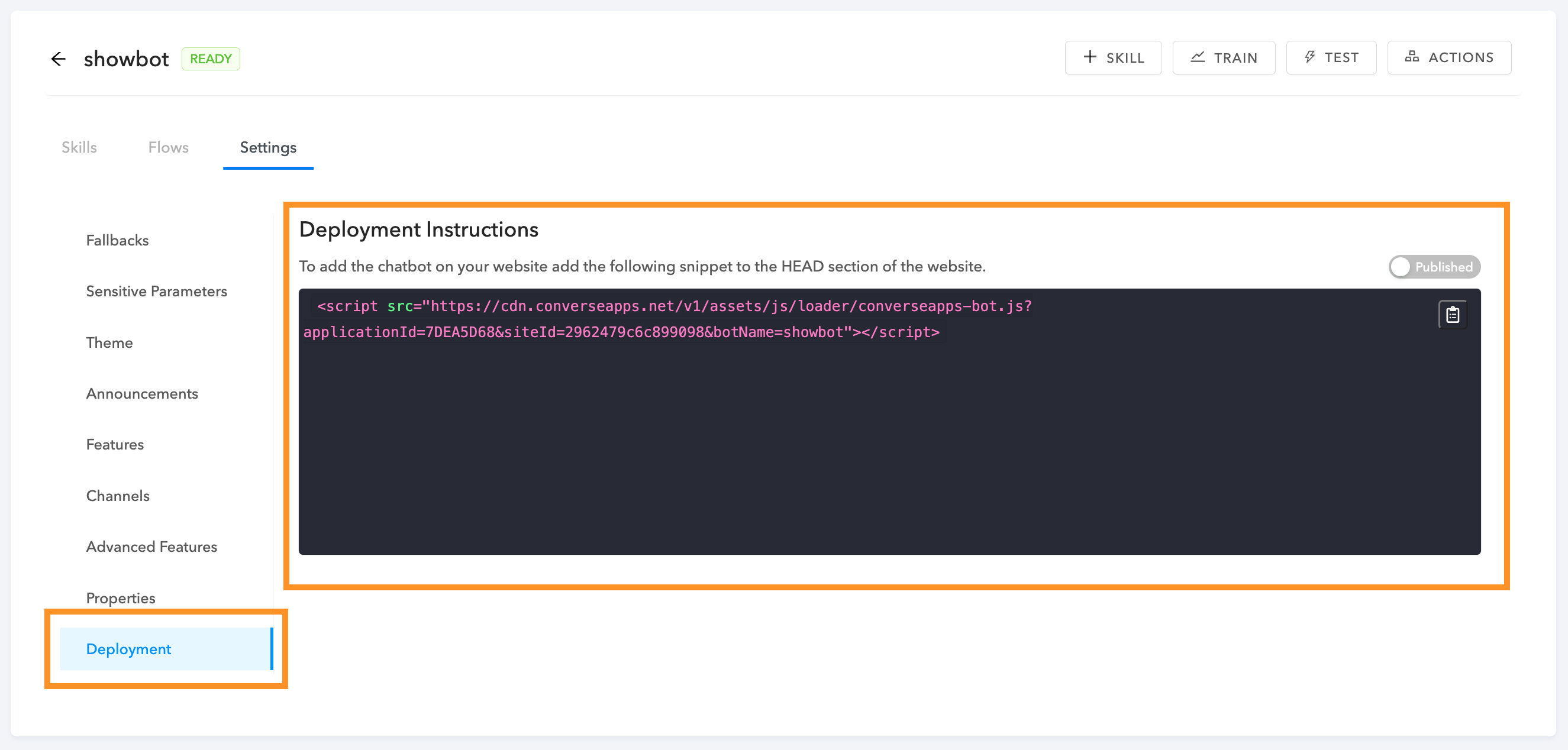
2. Navigate to the **Settings** > **Deployment** and copy the snippet for your chatbot.\
*Note: You can toggle between the **draft** and **published** version*
3. Next, add the script tag to the `head` or the `body` tag of the webpages you want the chatbot to be shown\
\
Navigate to the webpage you will now be able to see the chatbot appear.
### Note
The chatbot script is by default configured to always show the widget. In cases you want to customize when the widget shows and metadata refer to the article below.
{% content-ref url="/pages/rdwNMVg3tSR3j5x4PYmA" %}
[Custom Initialization and Passing Metadata](/product-docs/chatbots/deploy/custom-initialization-and-passing-metadata.md)
{% endcontent-ref %}